

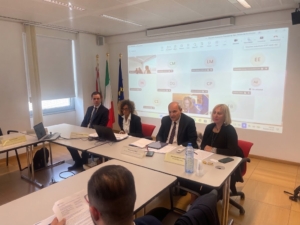
Ships change, commodities change. Above all, however, skills change. This morning, at Tuscany Regional Administration’s headquarters in Brussels, the North Tyrrhenian Port Network Authority presented a handbook that will reshape the landscape of port professions over the next three years in six key ports across the Mediterranean and Northern Europe: Genoa, Livorno, Piraeus, Rotterdam, Venice and Valencia.
The occasion was the closing meeting of the European NeXTraIn.PortS project, led by the Port Network Authority (PNA). The project aims to equip port workers with the skills of the future, with a specific focus on digital and energy transition.
The document is the result of a survey carried out by the project’s organizers amongst port companies in the spring of 2025 and cross-referenced with labour market data and the European ESCO classification. It identifies 29 professional categories divided into four groups: senior executives, middle managers, technical and administrative staff, and frontline workers. From CEOs to crane operators, from energy transition directors to container yard workers, every role is detailed with unprecedented precision. The breakdown covers required education, mandatory certifications, skills to acquire, and—crucially—the new skills demanded by the twin digital and energy revolutions transforming European ports.
Cybersecurity, digital twins, AI, alternative fuels like hydrogen and ammonia, and augmented reality: terms which, until a few years ago, seemed entirely unrelated to port work and which now appear, to varying degrees, in the job descriptions of almost all the roles surveyed, from managers to manual workers.
However, the survey also highlights a problem concerning the composition of the workforce. In 40% of the companies investigated, there are no women on the board of administration, whilst in a further 40%, the proportion of women is less than 25%. The situation improves at middle management level but becomes more critical again in operational positions: in 22 % of organizations, there are no women on the staff.
Average age is also a factor to bear in mind. In 66% of companies, workers aged between 18 and 24 account for less than a quarter of the workforce. The largest age group is people aged between 35 and 54.
For the industry, this means having to tackle both generational change and upskilling people already working in ports simultaneously.
This is precisely what Livorno Port Authority’s training experts, led by manager Claudio Capuano, focused on during NeXTraIn.PortS closing meeting. They put forward a proposal intended to go beyond the scope of the project: setting up a Community observatory on port professions, capable of building on the current partnership and gradually expanding to European level.
The proposal didn’t fall on deaf ears. It was picked up, during the event, by institutional representatives from Tuscany & Liguria Regional Administrations and the Generalitat Valenciana, as well as Assoporti ( the Italian Port Association), represented by Tiziana Murgia, participating remotely.
Augmented reality training scenarios were also presented, alongside classroom-based activities carried out in the field and e-learning platforms tested during the international mobility programmes organized as part of the project.
“The message is clear from the technical details set out in the manual, and even more so in the requests put forward in Brussels: without targeted training in energy and digital technology — and, above all, without genuinely opening the doors to women and young people — European ports risk being left behind just as the industry is undergoing its most significant transition,” said the PNA senior executive. “It is not just infrastructure that is changing, but also the people who work at the port. The most important message, for me, is that there can be no technological transition without a skills transition: we need to invest in the skills required to understand, manage and use new technology. The proposal for a permanent skills observatory could be the first step towards transforming this handbook from a snapshot of a particular moment into a dynamic planning tool, shared amongst all Europe’s ports,” he added.
Mr. Capuano’s view was fully endorsed by Tiziana Murgia, who wished to congratulate the North Tyrrhenian PNA on the work carried out in the NeXTraIn.PortS project: “I believe that training is central to the future of our ports,” he said, adding that “as Assoporti, we are convinced that ports are not merely infrastructure, but complex ecosystems that require training in a wide range of professional skills, all of which must work together”
The Italian Ports Association manager is convinced of this: “We need qualified professionals capable of leading this process. Digital transformation and new technologies are changing the way we work in ports, and the people who work there are changing alongside the technology. For Assoporti, training is a key issue in all matters relating to digitalization: we need to invest in human capital.”
Translation by Giles Foster