
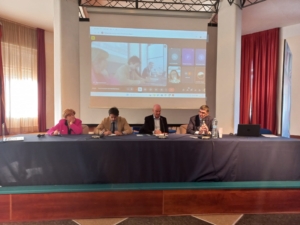
The North Tyrrhenian Port Network Authority launched a proposal to set up a Mediterranean gender equality network at the end of the ‘Inclusive Mediterranean Ports – Gender Equality Strategies in the Port System’ conference this morning, The conference was organized in Livorno by the Joint Committee for Equal Opportunity (CUG)), the Port Authority body whose role is to advise, make proposals and carry out audits in view of promoting equal opportunities, well-being at work and the prevention of discrimination in the workplace.
“European and international data tell us that women represent about 22% of the workforce in the transport industry in the EU. In the maritime-port sector, however, it is currently under 20%, with minimal peaks in operational and technical areas,” said CUG President Antonella Querci at the opening of the conference, pointing out that the percentage of women on board ships is estimated at around 1%, while in Italian port companies it does not exceed 8%.
It is a rather bleak picture, which is offset by the high level of female empowerment in the institutional sphere: At the European Sea Ports Organization, almost half of the professionals in technical committees are women. In ports like Barcelona women make up over 30% of the workforce with even higher percentages in non-operational sectors. At the North Tyrrhenian Port Network Authority, women account for about 46% of the personnel.
The widening gap between the two contexts requires practical measures, comparative monitoring, and cooperation networks that convert good practices into real change. Hence the PNA’s intention to present a proposal for a European project dedicated to setting up a Mediterranean network of ports committed to certification and gender equality policies.
“The Mediterranean”, said Querci, “has always been a trading centre, a natural bridge between continents, cultures and production systems. Today, with the growth of the Blue Economy, it’s the ideal place to experiment with new forms of inclusive cooperation.” The Port Authority’s intention is that setting up a network of inclusive ports would give women access to a wide range of skills and, at the same time, offer ports a tool for strengthening more stable, innovative commercial and institutional relationships.
“Mediterranean ports have a responsibility and an opportunity ahead of them: to transform gender equality into a key factor for innovation. The challenge is to make inclusion a common way forward towards the future.” This is the challenge inclusive Mediterranean ports face: “to build networks that unite people, skills and visions, and use inclusion as a common route towards the future.”
Inclusion was discussed in depth during the conference which brought together operators, representatives of institutions and associations, and marked the conclusion of the process that led the Port Authority to obtain quality gender equality certification.
At the opening of the conference, PNA special commissioner, Davide Gariglio, pointed out how the European port and maritime sector is currently undergoing a period of profound transformation. “Technological innovation, energy transition and digitalization are redefining port life, expanding its activities and skills far beyond the boundaries of its traditional core business. In this scenario, promoting the presence of women becomes not only a matter of social justice, but also a strategic lever for competitiveness and innovation,” he said.
For the leading figure of the ports of Livorno and Piombino, promoting female resources is not only a matter of social justice but also a strategic lever for competitiveness: “There is still a lot to be done, but changes are already happening. We need to encourage all port companies to address the issue of social equity and provide good training: investing in young people and new generations so that they are taught the Culture of Respect.”
The mayor of Livorno, Luca Salvetti, shares this view. In his speech, he listed both the various obstacles that currently prevent women from fully participating in the port workforce (work-life balance; under-representation, limited access to training) and the opportunities brought about by change (technology and innovation, the growing importance of administrative and technical skills, environmental safety and sustainability, “which offers women opportunities for development”).
“In Italy, Livorno stands out as an example of best practices, and the Port Authority is a decisive lever for creating a more equitable, inclusive society,” said the mayor. He pointed out that women are also a driving force in the municipality, as 70% of its employees are women. “The municipality is more efficient where female experience is clearly evident,” he pointed out, expressing the administration’s willingness to collaborate with the Port Authority on these issues.
The regional councilor for equal opportunities, Maria Grazia Maestrelli, also highlighted how changes driven by technological innovation, digitalization and sustainability are now triggering processes capable of generating greater gender equality. However, there continue to be a number of critical issues concerning the timing and ways in which this equality should be pursued. The councilor appointed by the Ministry of Labour to deal with various forms of discrimination in the region pointed the finger at companies that “in our beautiful Tuscany advise women to leave their jobs as soon as they get pregnant,” She pointed out that harassment, not only sexual harassment but also other forms that are more difficult to identify, is still widespread.
From the conference – which featured contributions from a number of speakers, including the Secretary General of the European Sea Ports Organization, Isabelle Ryckbost, the Head of Corruption Prevention at Assoporti, Tiziana Murgia, and the Director of the European Institute for Gender Equality, Carlien Scheele – a complex puzzle of global challenges and changes emerged, confirming that full gender equality is achievable, even if there is still a long way to go.
The North Tyrrhenian Port Network Authority set out on this journey with great conviction, making gender equality a key part of its sustainability strategy and, in March 2025, becoming the first Port Authority ever to obtain gender equality quality certification.
Now it’s time to press on. That is why, at the end of the conference, the PNA announced its launching a new initiative to develop the Gender Equality Pact for the North Tyrrhenian Port Network. According to the Port Network Authority and the CUG, the Plan will not be a document of mere principles, but a participatory process capable of having a tangible impact on port and regional development, addressing welfare issues for work-life balance, defining training and mentorship programs to open up new port professions to women, promoting governance that permanently integrates the gender perspective into strategic decisions.
According to the CUG President “The Pact could become the basis for a European observatory, a tool that allows us to monitor developments in the sector, share data and promote ports that make inclusion a real lever for growth.”
Translation by Giles Foster