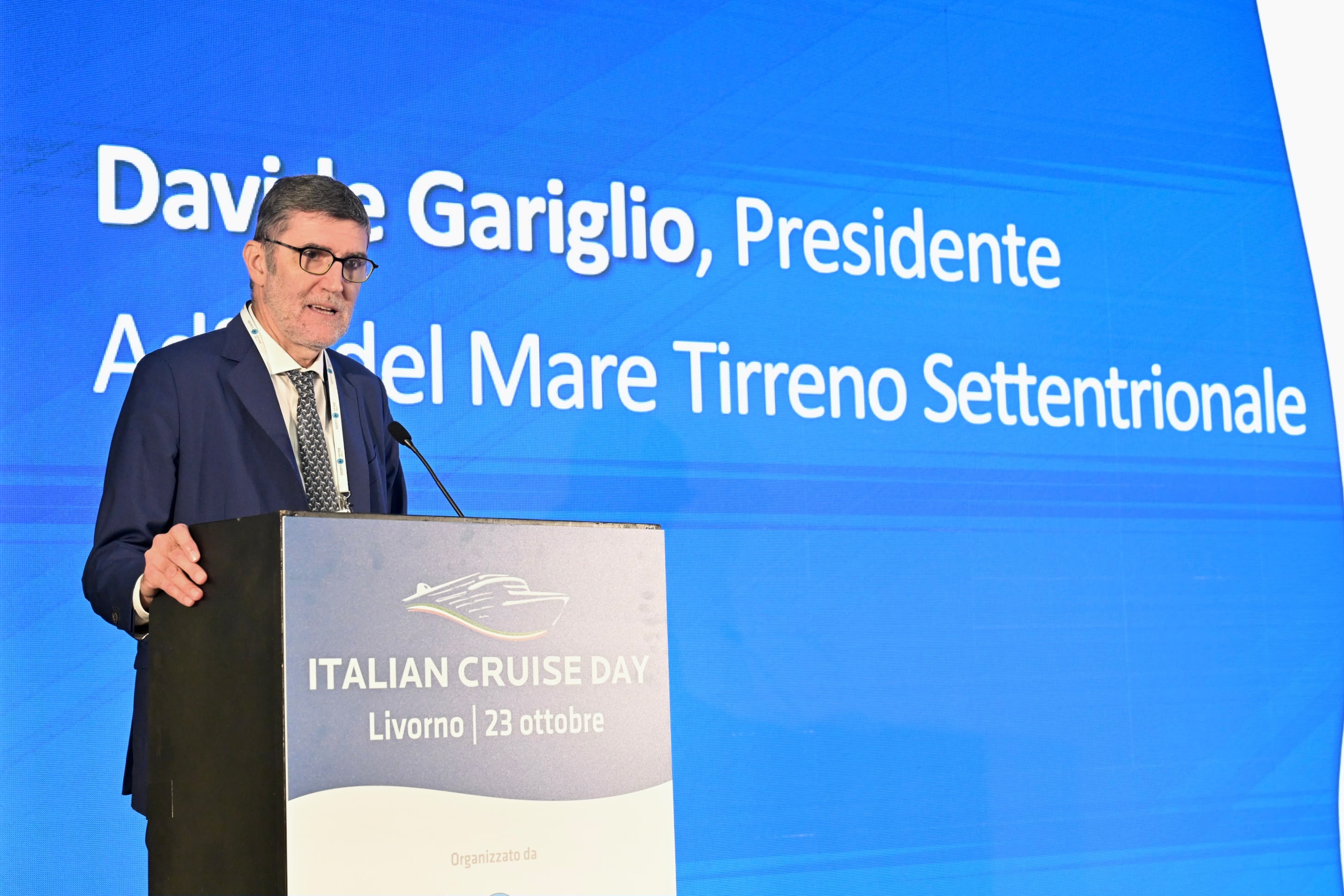
Passenger traffic is growing and the number of port calls is increasing even faster. In the first nine months of the year, North Tyrrhenian ports welcomed around 670,000 cruise passengers, 4% more compared to the 2025 season. The main driving force behind this growth is the number of port calls, which totalled 333 during the period in question , + 15% compared with the January– September one.
The figures were presented by Davide Gariglio, President of the North Tyrrhenian Port Network Authority (PNA) at the opening of Italian Cruise Day, Italy’s most important event dedicated to the sector, which this year was hosted in Livorno. “These figures are source of great satisfaction to us,” Mr. Gariglio commented.
The figures reflect the scale of a phenomenon that involves not only the port, but a whole network of local services and operators.
Deputy Minister Edoardo Rixi also highlighted this point in his video message: “Livorno and Tuscany have significant potential for developing passenger traffic,” he said, emphasising that the infrastructure to be built in Livorno – designed to systematically manage both passenger and goods traffic– will provide an even greater opportunity to attract visitors to our country.
“Obviously,” he added, “the aim is to work together with the PNA to identify synergies, complete the projects and provide the region with a development network. We need to do even more to help Tuscany manage these flows. The Tuscan port system is also vital as a logistics hub and as a key pillar for the peninsula’s tourist hospitality sector.”
It is precisely these dynamics and the sector’s development prospects that form the backdrop to Italian Cruise Day, an event created to facilitate dialogue between the key players in the national maritime sector. For the North Tyrrhenian PNA, the event also represents an opportunity to promote Livorno and Tuscany to shipowners and cruise lines, highlighting the region’s potential as a tourist destination.
The event originates from a desire to bring the national maritime cluster together and, in the Port Network Authority’s view, also serves as a showcase for the region. “We want to give shipowners, and cruise lines the opportunity to get to know our city and understand Tuscany’s potential,” explained President Gariglio . “Livorno,” he emphasised, “is the gateway to a region that boasts one of the world’s greatest artistic and cultural heritages.”
The President of the Tuscany Regional Administration, Eugenio Giani fully endorsed Mr Gariglio’s standpoint. Mr Giani highlighted just how important it is that an event like Italian Cruise Day is taking place in Livorno, at a time when the cruise industry is showing significant potential. “This,” he said, “is an opportunity to showcase Tuscany as a visiting card, thanks to its aesthetic appeal and its ability to highlight local areas and foster a sense of community. Cruise tourism is becoming an increasingly attractive option. It has to be nurtured with particular care. In this respect, Livorno and Tuscany are of exceptional value.”
According to Mr Giani, the cruise industry is becoming increasingly important for tourism, and Tuscany has enormous potential which needs to be developed. “We must not be afraid of tourism, because tourism means wealth and vitality. It is a potential we have to work on, and Livorno, a Tuscan landmark, has the capacity to promote elements that can become self-sustaining.”
The strategy outlined by Mr. Gariglio also focuses on boosting Tuscany’s appeal to tourists, with particular attention to small and medium-sized companies. “These are operators who,” as the PNA president pointed out, “have a very high spending power and can make a significant contribution to the city’s prosperity.”
However, one issue remains to be solved: hospitality. “As the Port Network Authority, we are firmly convinced that we need to do everything possible to improve passenger reception,” said Mr Gariglio, acknowledging that Tuscany currently lacks a cruise terminal of the standard it deserves.
The aim is to set up a process that will enable us to “take great steps forward” and establish a hospitality system that satisfies the region’s needs, with a specific objective: to foster development for businesses, well-being for the community, families, and employment.
“By discussing our views together, we can come out of this stronger, with more to do,’ said Gariglio, addressing the audience. ‘This is the approach we are adopting,’ he concluded.
Translation by Giles Foster