
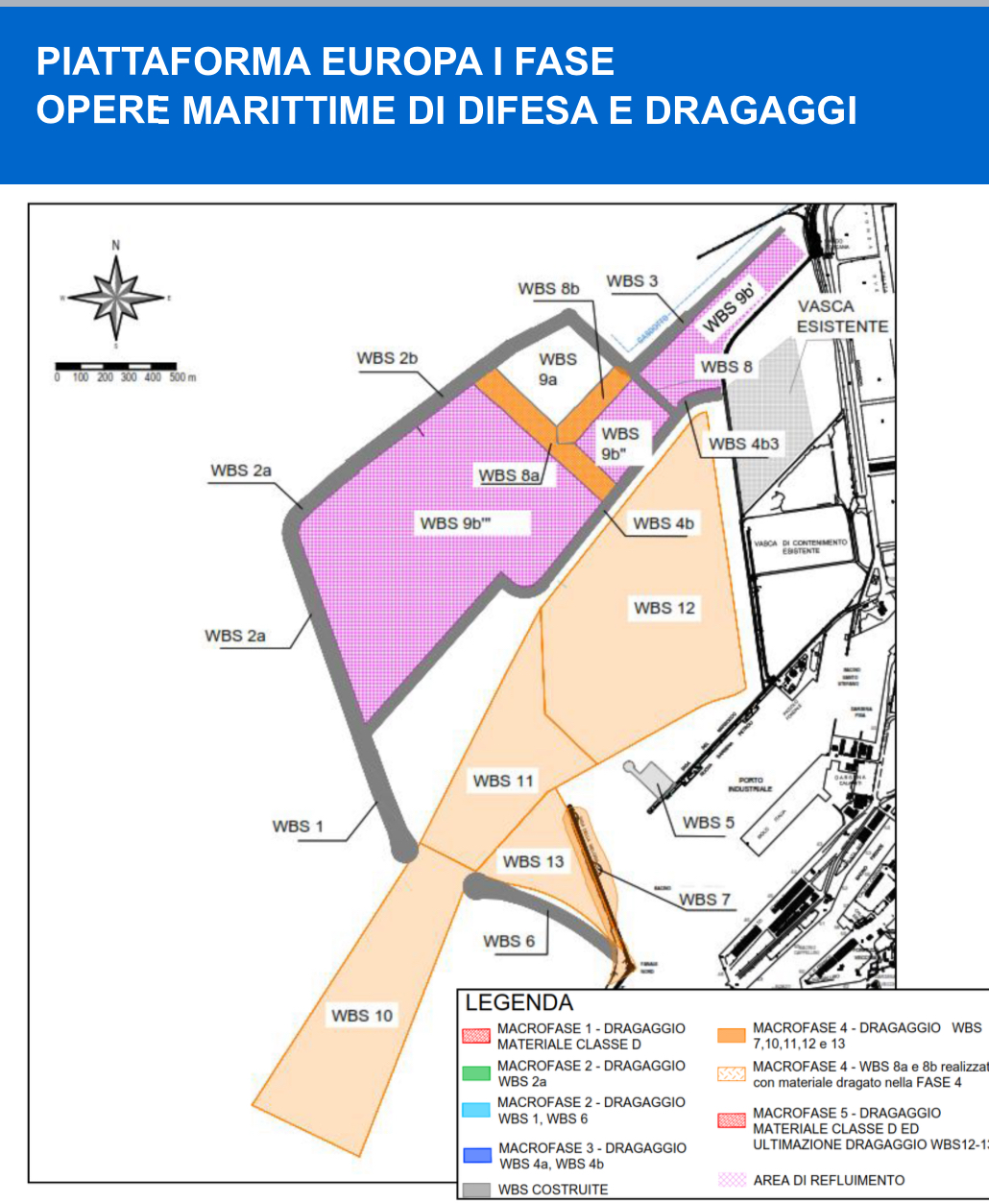
The monitoring of the Integrated Regional Infrastructure & Mobility Plan (PRIM) this morning in Livorno offered Port Network Authority (PNA) Special Commissioner Davide Gariglio an opportunity to take stock of the progress on the Darsena Europa, Livorno port’s mega seaward expansion infrastructure project, which, in its first phase, envisages the construction of a 620,000m2 container terminal with a 60,000 m2, 1,200m long quay and a 560,000m2 yard.
In the city’s District Council’s boardroom, Mr. Gariglio, speaking in live streaming, pointed out that dredging operations and building offshore breakwaters began on 12th May after the executive project and the removal of wartime debris had been completed.
He outlined the infrastructure’s timeline. The container terminal is to be up and running by 2030. The project envisages, among other things, widening the access road to the construction site, the construction of a new breakwater (Diga Nord) the reconfiguration and extension of the Marzocco breakwater (Diga Sud), the dismantling and reconfiguration of the northern section of the Meloria breakwater (Nuova Diga della Meloria) and dredging to bring the depth of the access channel down to -17 metres in the outer section and -16 in the inner section.
The consolidation of the first sludge containment facility, which began in 2023 is scheduled for completion in June 2027.
Mr. Gariglio pointed out that the total investment for the public part has now reached €555 million, one hundred million more than the original amount. This increase is partly due to the need to modify the initial project, envisaging the enlargement of the containment basin of the future RO/RO terminal in order to allow it to fully contain the 17 million cubic metres of sediment from the dredging operations. The consolidation of the first breakwater (costing approximately €50 million) and the environmental recommendations during the EIA phase have also affected the final cost of the mega infrastructure, as well as price increases, which will have to be covered, at least in part, by the project’s economic framework.
These expenses are fully covered by public subsidies, totaling €450 million, 200 million of which from Tuscany Regional Administration, which, according to Mr. Gariglio, is “an extraordinary commitment.” He stressed that “it is by no means to be taken for granted that a Regional Administration commits itself, to such a proportionally significant extent, to the construction of a port infrastructure of national importance.”
Additional financial resources have been acquired thanks to the loan contracts with the Cassa Depositi e Prestiti (€50 million) and the EIB (credit line of up to €90 million).
In any case, further requests for national and European funds will have to be submitted, in tandem with PNA funds and loans which have already been obtained, to carry out other operations to have the whole container terminal available. These include the consolidation of the second sludge containment facility and last-mile railway links.
The commissioner also dwelt on the strategic importance of Tuscany’s Simplified Logistics Zone. Its first steering committee be set up on July 23rd. It represents “the industrial policy lever to promote economic development in the area and make the port of Livorno very attractive.”
The last priority the Special Commissioner highlighted was the building of a new bridge over the overflow canal. Although this project is not strictly related to the Darsena Europa, everyone sees it as strategic for solving the problem of the difficult coexistence of the commercial port’s berthing requirements with the Pisan shipbuilding industry’s manufacturing ones.
Translation by Giles Foster