
Apparently not even Tehran’s allies are able to remain immune from the shockwaves of a conflict that, with each passing day, increasingly risks turning into a war of attrition.
Two days ago, the news that two COSCO group containerships were forced to abandon crossing the Strait of Hormuz says far more about the current situation than Trump’s latest outbursts do.
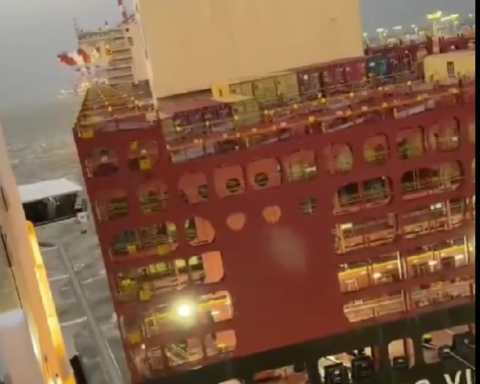
Last Friday, the CSCL Arctic Ocean and CSCL Indian Ocean, 19,000 TEU boxships, opted to turn back because they had not received assurances that they could safely exit the Persian Gulf. Although Iran had declared the strait open to ‘friendly’ nations such as China, the Iranian maritime authorities (IRGC) effectively stopped the vessels, claiming that they did not have the necessary permits to use the new controlled transit corridors.
It is difficult to understand the reasons behind Tehran’s U-turn – some analysts have pointed out that both ships had recently called at ports considered hostile by Iran in the current conflict, including Jebel Ali (Dubai), Dammam (Saudi Arabia) and Khalifa Port (Abu Dhabi). This is why they ended up on the Pasdaran’s target list – what is clear is that Iran’s tightly controlled transit model now makes access unpredictable even for operators from nations theoretically exempt from the blockade.
The suspension of services came, moreover, less than 48 hours after COSCO had announced it was taking bookings to destinations in the Gulf again. The Chinese shipping line had been the first major shipping company to do so since the conflict began.
Iran’s asymmetric warfare strategy (based on the use of inexpensive and easily concealable weapons to inflict disproportionate damage on a technologically superior enemy) could result in these routes remaining unsafe for a long time to come.
“With both the Red Sea and the Strait of Hormuz simultaneously blocked, the industry is facing a different kind of shock — one that hits both routing flexibility and fuel logistics at the same time,” says the analysis firm Xeneta, highlighting that carriers are already applying emergency surcharges and that transit times are changing once again due to rerouting.
A significant part of this pressure is now being felt in the bunkering sector (the supply of shipping fuel) and is a phenomenon that is widely misunderstood, according to the consultancy firm.
Xeneta points out, that the sector has already absorbed the rise in fuel costs over the past year. This is nothing new. “What is new is that key refuelling hubs are no longer functioning normally: carriers cannot reliably access fuel where and when they need it.”
Maersk’s CEO has spoken publicly about ships transferring fuel to one another while out at sea, simply to ensure that vessels can reach ports where refuelling is actually possible. It is therefore not a question of price but of operational feasibility. “Yet,” Xeneta claims, “carriers are introducing emergency fuel surcharges, framing it as a cost issue.”
While the constraints are operational and linked to specific locations, the impact is unlikely to be the same across all trade routes. Some routes are affected; others are not. “Without that nuance, you risk accepting charges that aren’t proportionate to the disruption actually affecting your supply chain.” the analysis firm adds, warning of the possibility that this could lead to a situation of operational stress that ultimately impacts the end consumer.
Unfortunately, Trump’s latest statements do not seem to be helping to normalize the situation.
The build-up of US troops in the region and growing concerns over the potential US ground invasion of Kharg Island – a major oil hub from which 90% of Iran’s crude oil is exported – appear to conflict with the tycoon’s desire to reach a peace agreement with a country whose regime, he claims, has effectively been decimated.
Nor does Israel’s intention to extend its control over southern Lebanon help to resolve the conflict quickly. They have declared that their aim is to exploit the window of opportunity created by the confrontation with Iran to reshape the regional balance of power.
The Houthis, who have recently resumed their attacks on Israel, are set to further extend the conflict, reigniting the crisis in Bab-el-Mandeb and the Red Sea, bringing a second shipping strait – alongside Hormuz – into the conflict at the same time.
“It is time for supply chain stakeholders to prepare for a situation where both Hormuz and the Red Sea continue to be chokepoints for a considerable amount of time,” says Lars Jensen, CEO of Vespucci Maritime.
Translation by Giles Foster