
Geopolitical turmoil in the Middle East has forced shipping companies to significantly redesign their maritime route networks.
Whilst the ports in the regions directly affected have lost their regular shipping route links, those in neighbouring regions have offset this loss, recording an increase in connectivity.
Sea Intelligence highlights this new trend in its report, drawing on data from UNCTAD’s Port Liner Shipping Connectivity Index (LSCI) for the third quarter of 2026.
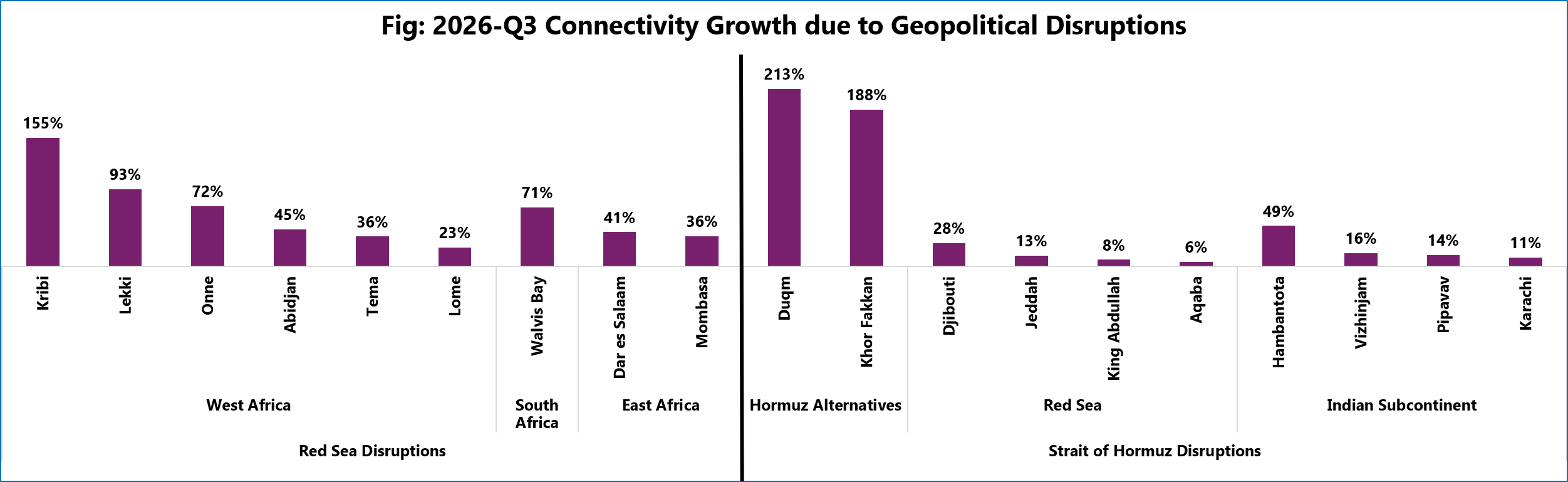
Due to major increases in transit times for vessels heading to the Central and Eastern Mediterranean opting to sail round Africa via the Strait of Gibraltar, shipping companies have shifted their transhipment operations further south along the African Atlantic coast. Consequently, West African ports have seen significant improvements in connectivity. Walvis Bay, on the other hand, has become an alternative to the congested port of Durban for ships sailing between Asia and Europe circumnavigating Africa.
Similarly, following the closure of the Strait of Hormuz, ports along the Gulf of Oman recorded significant increases in connectivity. Compared with pre-crisis levels, Duqm and Khor Fakkan have witnessed exceptional increases of 213% and 188 % respectively.
Ports in East Africa and on the Indian subcontinent are playing a key role as hubs handling rerouted regional cargo, serving shipping companies wishing to avoid the conflict zone entirely. This reorganization of maritime traffic flows has also led to increased connectivity at the ports of Dar es Salaam and Hambantota.
Translation by Giles Foster