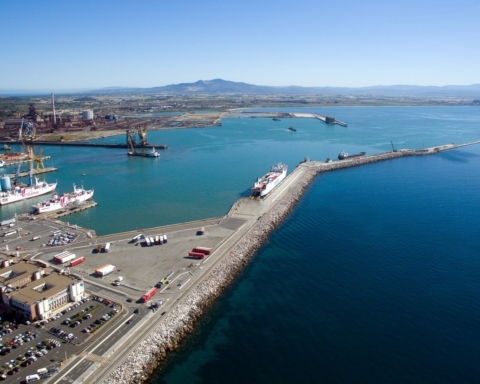

Since July 4th 2023, Piombino port’s regasification vessel has handled 91 LNG carriers and envisages using 100% of its regasification capacity by the end of the year.
This update was given in a speech by Carlo Mangia, Director of Operations at SNAM Energy Terminals, at a council meeting dedicated esclusively to the future of the Italis LNG, convened this morning by the Mayor of Piombino, Francesco Ferrari.
“The Piombino FSRU terminal, now an entirely Italian asset, is the most used Floating Storage & Regassification Unit in Europe in percentage terms and represents operational excellence,” said Mr. Mangia, pointing out that over the last four years, LNG has seen its share of gas flows coming into Italy grow from 10% in 2021 to 32% in 2025.
From January to October, LNG flows increased nationally by 42% on an annual basis, with Piombino making a decisive contribution. In 2025, the Italis LNG performed 39 unloading operations from methane tankers, accounting for almost 20% of tanker operations carried out nationally at the five regasification facilities.
Speaking at the council meeting – during which a debate was opened on the future allocation of the terminal, which, according to the authorization issued at the time by Special Commissioner Eugenio Giani, should leave the Piombino quay in July 2026 –the President of the Port Network Authority (PNA), Davide Gariglio, weighed up the negative and positive effects that the Italis LNG has had on the port.
Mr. Gariglio pointed out that the overlap between regasification operations and Piombino Industrie Marittime’s (PIM) shipbuilding activities has severely limited the development prospects of the joint venture between the Livorno-based Neri group and the Genoa-based San Giorgio del Porto one –which was forced to do without Piombino’s east quay to allow PIM to complete its shipbuilding activities. On the other hand, he pointed out that the Port Network Authority and the port cluster benefited greatly from the presence of the regasification facility, especially in economic terms.
The PNA president pointed out that his administration gets €590,000 in concession fees from SNAM every year. Not only that, in 2024 and 2025, LNG shipments connected to the arrival of methane tankers in the port of Piombino earned the Port Authority €2.18 million and €1.8 million respectively in port shipping charges (duties on goods), while anchorage fees earned €1.4 million and €1.032 million in the two years under investigation.
Technical-nautical services, which enabled the terminal to operate at full capacity and in complete safety, also generated significant revenue. In 2024 and 2025 (up to October), mooring activities for ships berthing at the regasification plant amounted to €805,000 and €736,000 respectively. Piombino’s harbour pilots’ turnover generated exclusively from regasification services in the two-year period was €727,000 and €690,000. The revenue from the tugboat fleet (up from 2 to 4 vessels) dedicated to the Italis LNG‘s operations, totalled €10 million in 2024 and €8.8 million in 2025.
However, according to Mr. Gariglio, there are certain issues that need to be addressed for the future. The first of these concerns the fate of the quay currently used by SNAM. Under Article 13, paragraph 5 of Decree Law 50/2022, the facilities now on the quay have to be kept there even if the Italis LNG is relocated. Hence this strategic area can no longer be used for the port’s development needs.
The PNA’s president pointed out that important projects are currently underway in the Piombino area for its steel industry. He was referring to the programme agreement with Metinvest-Danieli, signed in Rome before the summer, and the revision of the agreement with JSW. “These agreements should herald a significant relaunch of steel production activities in the regional area and, consequently, it will lead to a boom in port operations, which, however, will require suitable space and infrastructure”’ he said. He pointed out that he had begun discussions with the government on the necessary infrastructure work envisaged in the Port Masterplan. It involves narrowing the dock, building a west quay and the possibility of using new yards. These projects cannot be implemented at present due to the lack of a ministerial decree issued jointly by the Ministry of Infrastructure and the Ministry of the Environment authorizing the necessary dredging operations. “We are confident that we will receive authorisation within the next month,” he admitted, noting, however, that the funds needed to implement the new port layout are currently lacking.
Additional resources (approximately €50 million) would also be needed to build a new quay for Metinvest’s activities: “We are moving forward with designing the infrastructure project, but there is no financial coverage to start the work,” warned Mr. Gariglio, who clearly sees these issues linked to the future of the regasification vessel: “We need to know if and how long the regasification unit will remain in the port. This will obviously have an impact on the port economy and the timing and methods of implementation of the projects I have been talking about,’ he specified.
The president of the Port Network Authority concluded by pointed out that “we have a port that’s serving the country’s national interests in terms of energy and now also has to support strategic projects to revive the national steel industry. We are open to discussion with the government, but national policy decisions must also be tailored to local development needs. For this reason, he concluded, we believe it is of the utmost urgency to address the compensation issue together with the municipality and other institutions.”
Translation by Giles Foster