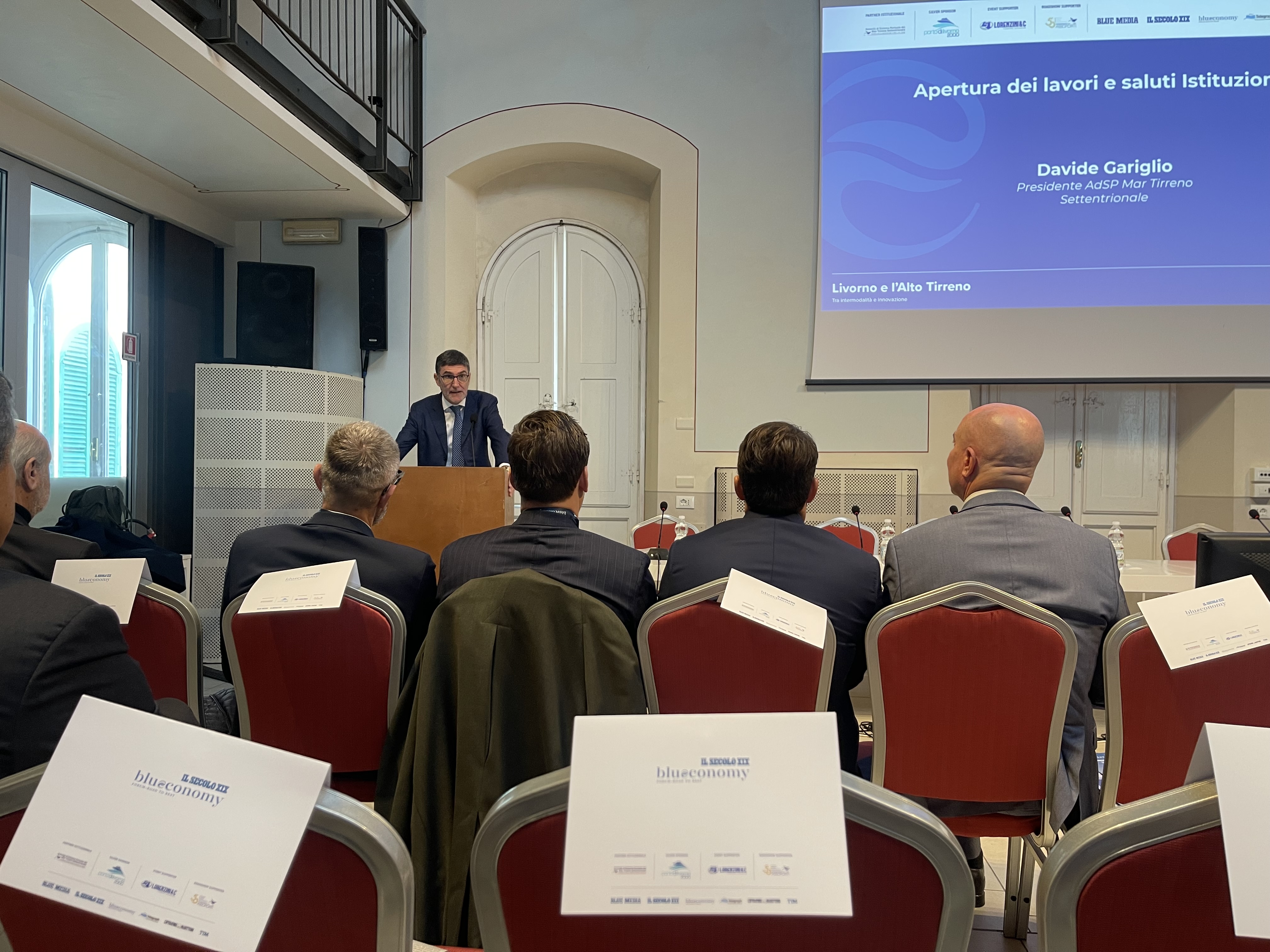
Provide for setting up a sort of structural fund for companies or agencies responsible for supplying manpower in ports. This is the idea that the new president of the North Tyrrhenian Port Network Authority, Davide Gariglio proposed at the Road to Best forum yesterday in Livorno, organized by the Il Secolo XIX group.
“We know that temporary port manpower workers receive compensation for each day they are not allowed to start work” Mr. Gariglio said during his introductory speech. “However, the temporary port labour companies or agencies are not entitled to any compensation during periods when they are unable to employ their workers.” As a result, “in times of crisis, they do not have the financial margins to keep the business running and cover costs such as rent, electricity, gas, and vehicle depreciation.” That is why “we need to think about a structural financial aid system to support this category,” the president of the ports of Livorno and Piombino concluded.
The PNA president’s proposal found major support in the maritime-port cluster, in particolar from the president of Livorno’s temporary port manpower agency (ALP), Jari De Filicaria. Speaking to Port News he recalled how Article 199 of Decree Law No. 34 of May 19, 2020, had already intervened in the past to address the effects of the COVID-19 pandemic, introducing economic support measures for port authorities and companies authorized to provide temporary port manpower. Now that this measure is effectively losing its impetus “we need to think of a structural solution that will allow this category to survive in a market characterized by a degree of flexibility that has now reached alarming levels, partly due to the emergence of phenomena such as naval gigantism,” says De Filicaia. He said an equally important priority is to fully implement the fund to support workers leaving the workforce (the measure, which became law back in 2021, is still awaiting an implementing decree) and to provide for the recognition of port workers’ jobs as strenuous.
Giuseppe Gucciardo, regional secretary of the FILT-CGIL union in Livorno, also agrees with the comments made by the North Tyrrhenian Port Network president’s line of thinking: “As a member of parliament, Davide Gariglio was among those who most strongly supported the need to provide the national port system with a safety net to cope with the pandemic crisis,” recalls the trade unionist, referring to Article 199 of the Relaunch Decree, which, he explains, “was created for this reason. It has allowed port manpower providers to obtain essential contributions from the Port Authorities to manage their budget imbalances due to a change in the economic conditions of the Italian port system.”
Now that the provisions of that decree have expired (there will be no renewal for 2026), it is imperative to think of new solutions: “Our market is now deeply influenced by geopolitical dynamics,” Mr. Gucciardo continues. “Port workers and port companies are the first to suffer from these dynamics, and are their victims. Without a means of support, our economic operators risk not surviving.”
The idea of an ad hoc fund for temporary port manpower workers was welcomed by the former president of Assologistica,Confetra and Livorno Port Authority, Nereo Marcucci: “Temporary port manpower workers,” he says, “were designed on paper to be self-sufficient. The basic principle underpinning the labour market was very simple: when you work, the goods pay for you and when you don’t work, you get compensation* for not being allowed to start work (*IMA -Indennità Mancato Avviamento). Today, this system has stopped working. We therefore consider a proposal that keeps not only workers afloat but also companies that have additional costs beyond mere wages to be a good thing.”
ANCIP Director General Gaudenzio Parenti finds Gariglio’s proposal very stimulating: “It is in line with what we at ANCIP have brought to the attention of the Ministry of Infrastructure, the House of Representatives’ and the Senate’ Transport Committees, and the Interministerial Committee for Maritime Policy,” he points out. “Maintaining the administrative and operational conditions of the legal entity referred to in Article 17 of the 84/94 Port Reform Law (i.e. regulated flexibility) is essential to allow Italian ports to operate. This is why we believe it is right to provide for an equalization mechanism capable of compensating the legal entity for the damage it incurrs by not being able to get its employees working. Temporary port manpower companies operate companies operate under legal monopoly conditions, in line with European Union principles., in accordance with European Union principles, and we believe that the regulated flexibility of this category must be preserved in the general interest of Italian ports.”
Roberto Alberti, president of the terminal operator section of Confindustria Toscana/Centro, shares Mr. Parenti’s view: “It is right to use everything at our disposal to best manage the repercussions of a market where sudden drops in traffic and the consequent deviation from the start-ups envisaged in labour pool development plans are clearly putting the organizational model governed by Law 84/94 in serious difficulty,” he states. However, He stresses that this idea has to be placed in a different context from the current one: “The time has come to review the work organization model in ports, especially in Livorno, where public procedures aimed at identifying temporary manpower providers are being progressively updated,”
Translation by Giles Foster