The tension in the Middle East remains high after Iranian missiles recently hit the huge Soroka hospital in Beer Sheva, in Southern Israel, injuring 65 people, while the Jewish state attacked the Iranian reactor in Arak.
However, boxship traffic in the Middle East does not seem to have been impacted by the escalation of geopolitical tensions in the area. Many shipping companies have maintained their scheduled services and calls in the Gulf ports and Israel. They have, however, admitted that the situation is highly volatile and hence possible changes in the modulation of the various networks are not excluded.
ZIM, for instance, in a note to customers, stated that it would continue to accept bookings on shipments to and from Israel by sea. “Despite the escalated security situation, operation in the Israeli ports of Ashdod and Haifa is continuing as usual.” the shipping company says.
In view of the situation, the shipping line points out, however, that insurance companies have imposed an additional premium for war risk insurance on all vessels calling at Israeli ports. According to Reuters, war risk insurance premiums, paid when ships call at Israeli ports, were as much as 1% of the ship’s value, up from 0.2% a week ago.
Consequently, the carrier has stated that it will charge these extra costs to the end user with a war risk premium surcharge ranging from EUR 50 to EUR 120, depending on the scheduled service chosen.
In response to the evolving geopolitical scenario in the area, CMA CGM also said that it will closely monitor developments in the conflict, giving top priority to the safety of their crews on vessels crossing the Red Sea.
Other carriers have instead decided to steer clear of the Red Sea, opting for the more convenient Cape of Good Hope route, which has become the preferred trade route for East-West trade following the Houthi raids against merchant ships.
What is certain is that after the Israeli attacks on 13th June, Operation Rising Lion, launched to target Iran’s nuclear programme and bring down Tehran’s military leadership, has turned into a conventional war between two non-neighbouring countries.
Should the crisis escalate to such an extent that it leads to the closure of the Strait of Hormuz, not only the oil market but also the container one could suffer.
According to Linerlytica, the possible closure of the stretch of sea separating the Persian Gulf and Oman could put up to 3.4% of global container volumes at risk.
The United Arab Emirates would be the most heavily impacted if this happens. 21.7 million TEUs transit the Asian state’s ports annually, 2.2% of the global container volume and 65% of the total containers handled in the region. The port of Jebel Ali, operated by DP World, caters for 132 liner services, 30 of which are intra-regional. The rest pass through Hormuz.
Linerlytica admits that the risk of the blockade of Hormuz remains low, however, because Iranian ports are heavily dependent on access to the Gulf for the handling of the 2.5 million TEUs that are loaded/unloaded in its ports every year.
It is no coincidence that the Strait has now been spared the consequences of the war between Israel and Iran, except for interfering with shipping, Almost a thousand ships in the Gulf have been affected, according to Windward.
Jamming, the interruption of Automatic Identification System signals, has become a very common practice in conflict areas. This type of attack effectively blocks satellite signals, indicating false ship positions on the map and greatly increasing the risk of accidents at sea.
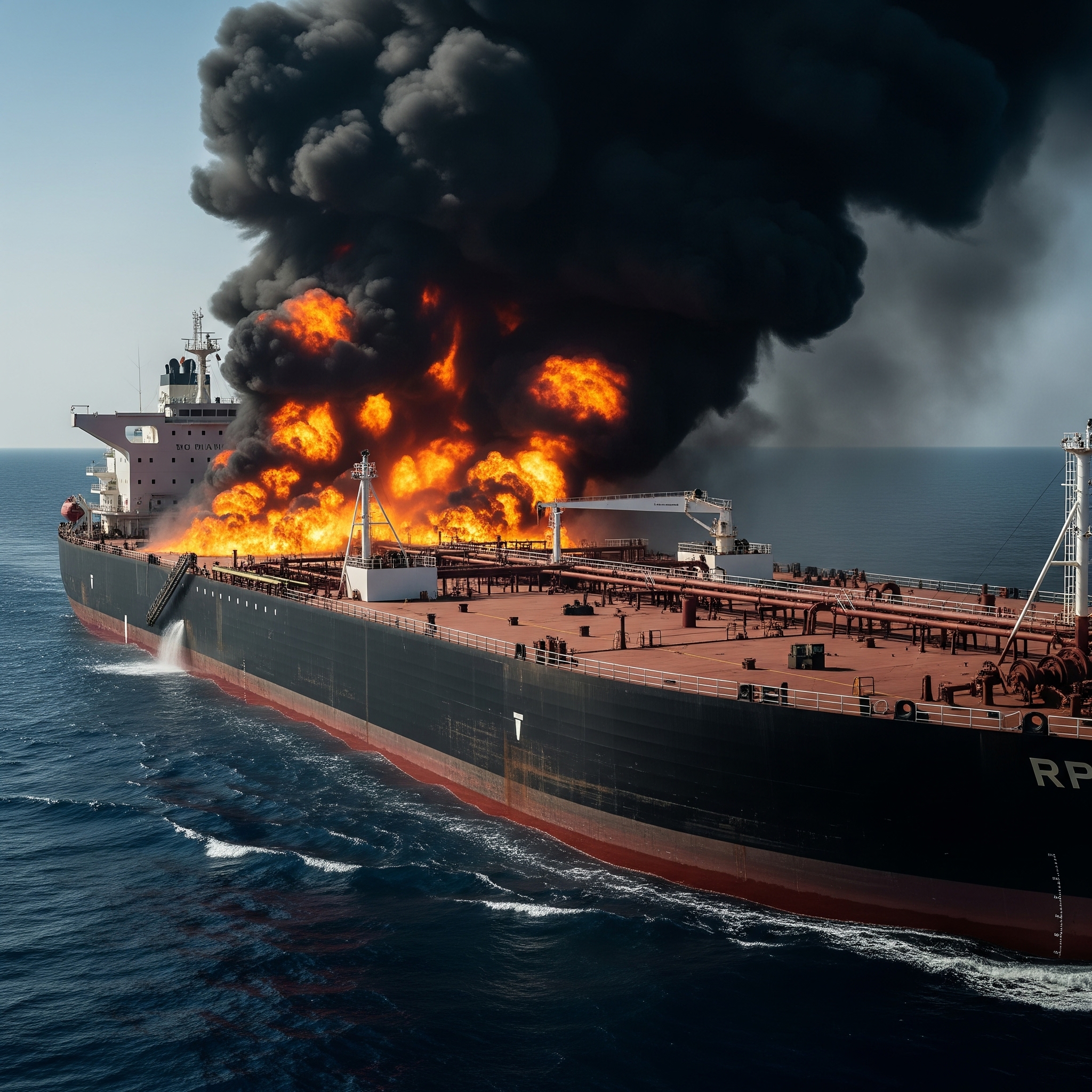
The latest incident took place a few days ago: an oil tanker collision south of the Strait of Hormuz. The Front Eagle was sailing towards the port of Zhoushan in China at a speed of 12.1 knots when it made a sudden turn to starboard, causing it to collide with the Adalynn’s stern portside, which, in turn, was proceeding on a south-easterly course towards the Suez Canal.
Apparently, it was a particularly strange manoeuvre, which has fueled suspicions among experts that the two ships had suffered electronic interference, distorting their positions.
In this respect, the JMIC (Joint Maritime Information Centre), which, as is known, is part of the US-led Combined Maritime Forces, has, however, classified the collision between the tankers as navigation-related and unrelated to the Iran-Israel conflict.
Translation by Giles Foster