
Container shipping is preparing to undergo one of its most significant transformations in the last few decades. According to Maritime Analytica’s data, based on Alphaliner’s, between 2020 and 2026, the leading shipping companies have embarked on a massive fleet expansion, radically reshaping the dynamics of the sector.
The change does not only concern fleet sizes, but also industrial strategies, the distribution of power among operators and the sector’s economic prospects in the medium term.
In 2020, the top five global operators were Maersk, the undisputed global leader, with a capacity of approximately 4.19 million TEUs, followed by MSC with 3.83 million. COSCO, CMA CGM and Hapag-Lloyd came in next. somewhat behind.
At that stage, the market was heavily influenced by the effects of the pandemic, with high demand, port congestion and exceptionally high freight rates.
Six years later, the scenario appears to have changed significantly. The surge in orders for newbuildings, combined with acquisitions in the second-hand market, has significantly altered the global ranking and distribution of capacity. The expansion phase, which began at the height of the traffic boom, is now entering a more mature one, where the risk of oversupply is becoming increasingly real.
MSC
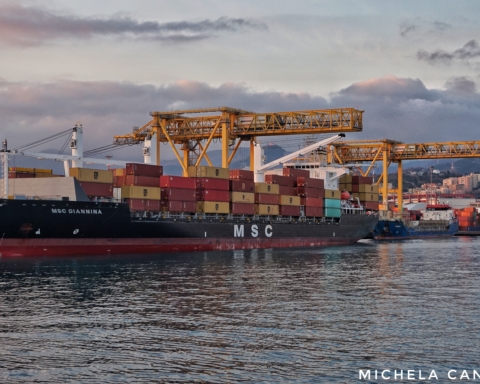
MSC (Mediterranean Shipping Company) is the real protagonist of the new phase. According to market forecasts it set to reach a capacity of approximately 7.10 million TEUs in 2026, nearly double its 2020 one.
This unprecedented growth has enabled the Italian-Swiss group to firmly establish itself as world leader, overtaking Maersk and strengthening its presence on all major global routes.
MSC’s expansion is due to a combination of new orders, buying second-hand ships and a strategy clearly geared towards gaining market share. This approach has enabled the company to strengthen its role in East-West and North-South traffic, consolidating a dominant position that is set to influence the sector’s competitive dynamics.
Maersk & CMA CGM
Despite increasing its capacity to around 4.60 million TEUs, Maersk has lost its global leadership position. The Danish company seems to be increasingly focusing on an integrated end-to-end logistics strategy, prioritizing added value, digitalization and services on land over fleet growth alone. Its aim is to transform itself from being a simple ocean carrier into a global logistics operator.
On the contrary, CMA CGM stands out as one of the most dynamic operators, with a capacity estimated to be around 4.10 million TEUs, allowing it to overtake COSCO and consolidate its position as one of the top global operators. The French group combines investments in new ships with strengthening its presence in key logistics hubs.
COSCO & Hapag-Lloyd
The Chinese group COSCO continues to expand, with a capacity of around 3.60 million TEUs. It continues to have a strong global presence, but its growth is slower than its main competitors. Hapag-Lloyd, with a capacity estimated to be approximately 2.40 million TEUs, confirms a more cautious, stability-oriented strategy, focusing on operational efficiency and financial strength.
Risk of overcapacity
The surge in newbuildings raises questions about a possible oversupply of cargo capacity. After the peaks in demand during the pandemic, the market is now showing signs of normalization, with more moderate growth in volumes and increasing pressure on freight rates. The arrival of numerous new ships could reduce the sector’s profit margins and boost competition.
In this context, the new geography of container shipping is not just a question of ranking. It reflects profoundly different industrial strategies. On the one hand, we see operators focusing on scale and market share, and on the other, there are those who prioritize integration, services and resilience.
It’s a period of major changes that are set to affect the industry for years to come, in an increasingly fiercely competitive market scenario.
Translation by Giles Foster